
A paper mill turns pulp fibre — virgin wood pulp, recovered paper or agricultural residue — into a continuous web of paper that is wound into large rolls at the end of the machine. Those rolls are the mill's finished goods, and every time one is moved, it can be crushed, scored, telescoped or dropped. Roll handling is therefore not a warehouse afterthought; it is the last stage of the paper mill production process and one of the few places where a mill can still lose value after the paper is made. This guide looks at how roll handling actually works, where paper mill cost accumulates, and how paper roll clamps and roll upenders change the economics of the shipping floor.
What a paper mill produces, and why rolls are hard to handle
Paper mill products are graded by basis weight, diameter and end use: newsprint, printing and writing grades, packaging board, tissue and specialty papers. A mill that runs a wide product mix will produce rolls of very different diameters and weights off the same site, sometimes within the same shift. That variability is the core handling problem.
A roll is a wound cylinder with no pallet under it and no rigid structure of its own. It has to be gripped on its curved surface, lifted, rotated and set down without marking the outer wraps, because the outer wraps are the saleable surface. Clamping force that is too low drops the roll; clamping force that is too high leaves pressure marks that get rejected downstream. This is why paper roll handling is done with purpose-built hydraulic attachments rather than forks and a sling.
Rolls behave differently from palletised loads
- Contact is curved, so grip pressure is concentrated on a narrow band.
- Rolls are dense — a large-diameter roll can weigh several tonnes in a small footprint.
- They rotate, so orientation changes are part of normal handling, not an exception.
- They are sensitive to impact and to moisture, so outdoor or rough handling is costly.
The paper mill production process, from pulp to shipping floor
The front end of the mill is pulping and stock preparation, followed by forming, pressing, drying and reeling. By the time the reel leaves the winder, the paper is finished — everything after that point is logistics. The typical flow is winder to wrapping line, wrapping line to warehouse or loading bay, and then into a container, trailer or rail car.
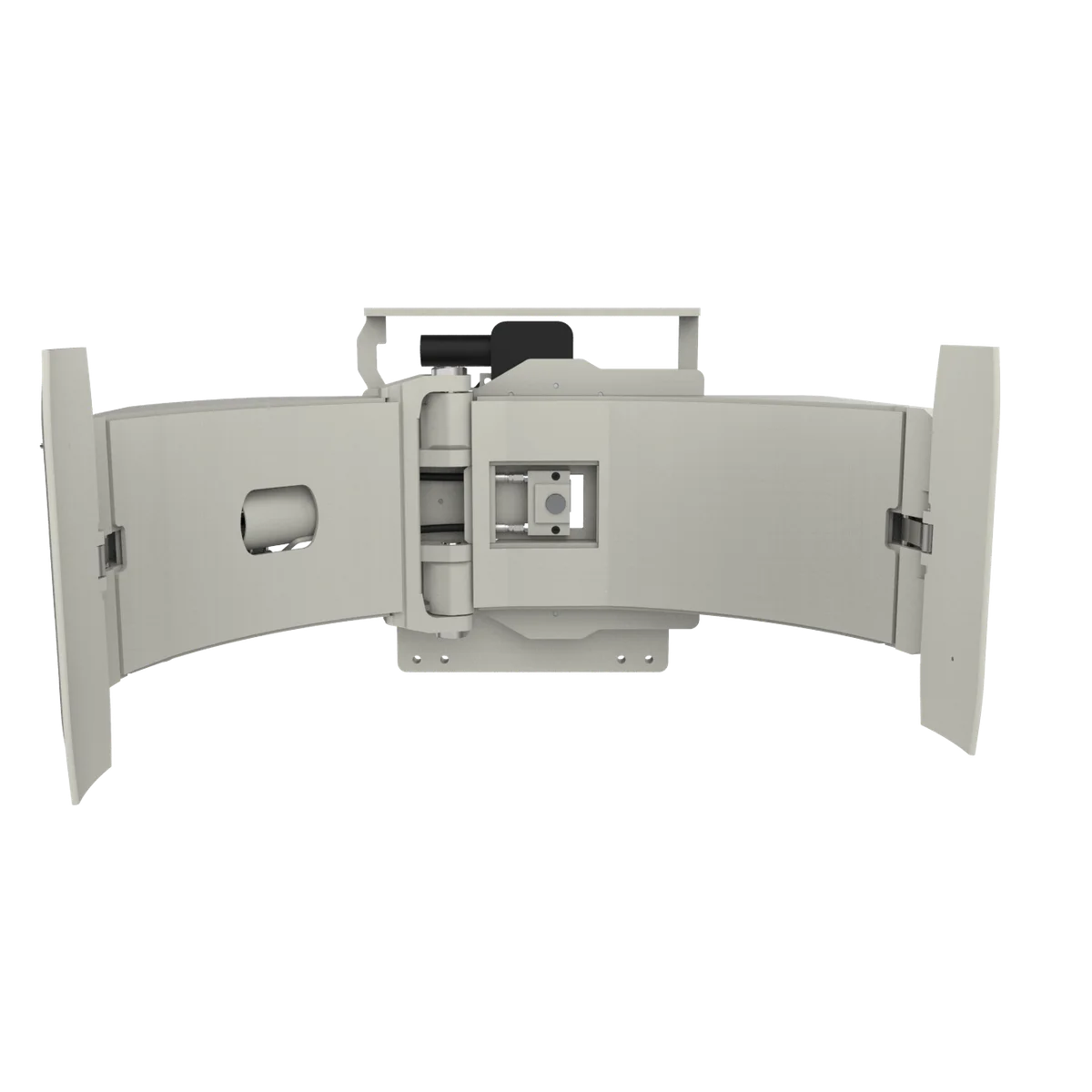
Each transfer is a handling event, and each handling event is a chance to damage the roll. Mills that still use forks, slings or improvised booms generally see higher damage rates, slower cycle times and more reliance on manual labour at the loading bay. Purpose-built attachments remove most of that variability by making the grip and rotation part of the machine, not part of the operator's judgement.
Where paper mill cost actually builds up
When people search for paper mill cost, they are usually looking at two different numbers: the capital cost of building or re-equipping a mill, and the operating cost per tonne of paper shipped. The second number is where handling decisions show up.
Roll damage is the most visible cost. A crushed or marked roll is either downgraded, rewound or scrapped, and the mill has already paid for the fibre, the energy and the machine time. Secondary costs are less visible but compound over a year: pallets and their repair, extra labour on the loading bay, slower truck turnaround, and the safety exposure of handling heavy cylindrical loads with the wrong equipment.
This is also the reason paper mills shutting down in high-cost regions often cite conversion and logistics cost pressure rather than papermaking technology alone. Older mills running manual or semi-manual roll handling carry a structural cost disadvantage against newer capacity, and paper mills around the world compete on the same export markets.
Paper roll clamps: the standard tool for roll handling
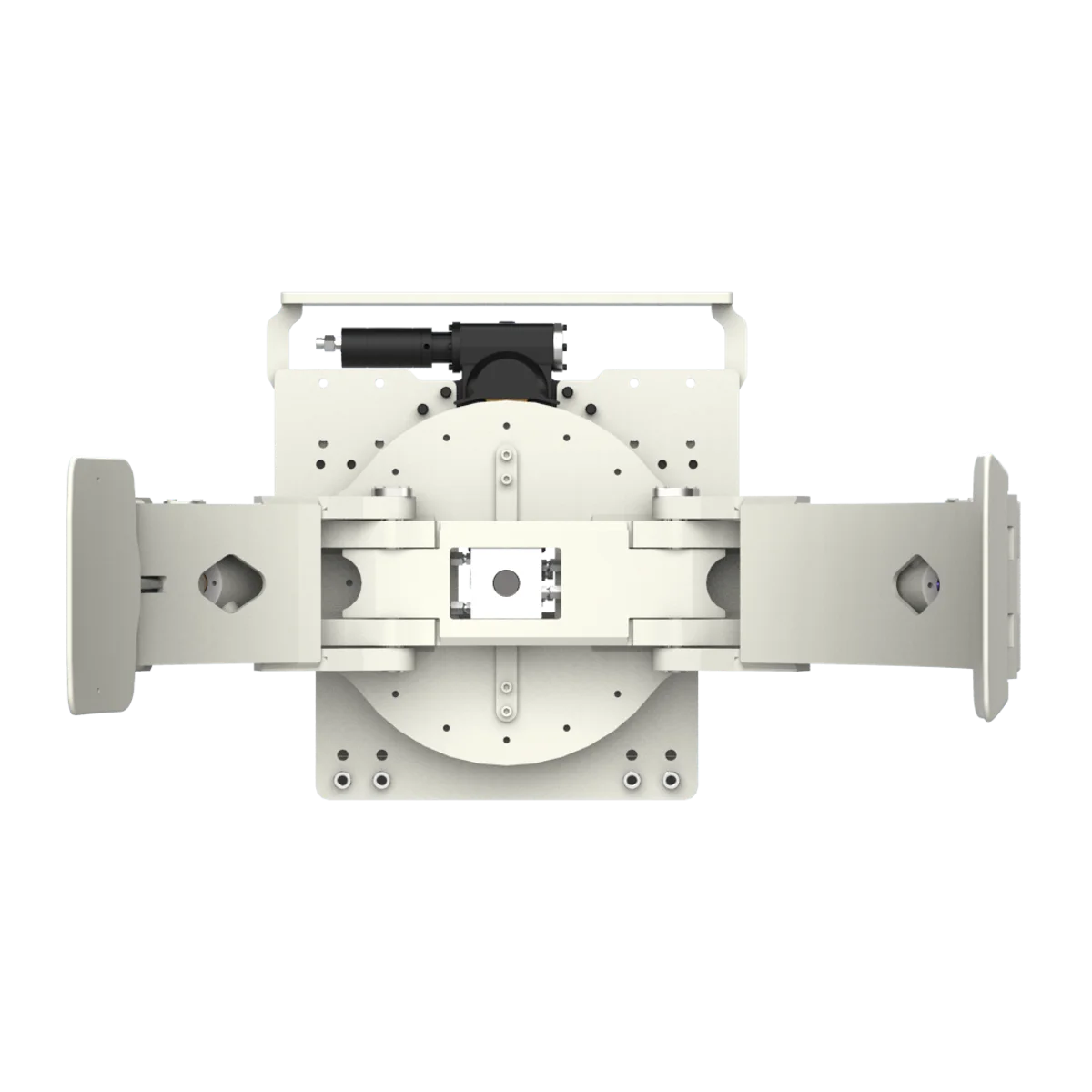
A paper roll clamp replaces the forks entirely. Two arms close hydraulically on the curved surface of the roll, and a rotation function lets the operator turn the roll from vertical to horizontal or the reverse without leaving the seat. WONTONNE builds a full range of these attachments for mills, printers, converters and warehouses.
Choosing a clamp starts with three numbers: roll diameter range, roll weight and the load centre at which the truck must still be stable. Fixed short arm clamps suit a narrow, consistent roll population. Positioned short arm clamps let the arm adjust to the roll width, which is what a mixed-diameter mill needs.
Matching the clamp to the roll population
| Attachment | Capacity | Typical roll range | Best suited to |
|---|---|---|---|
| 12G Paper Roll Clamp | up to 1200 kg | 350–1150 mm and wider variants | Light to medium rolls, general warehouse work |
| 15F Paper Roll Clamp | up to 1300 kg | 330–1150 mm, 410–1300 mm | Medium and small diameter rolls, newsprint, printers |
| 24G Paper Roll Clamp | up to 2200 kg | 350–1150 mm up to 440–1400 mm | Standard mixed-grade mill and converter duty |
| 20G Paper Roll Clamp (Fixed Short Arm) | up to 2000 kg | 530–1300 mm up to 630–1600 mm | Stable clamping with an excellent field of vision |
| 20G Paper Roll Clamp (Positioned Short Arm) | up to 2000 kg | 250–1300 mm up to 350–1600 mm | Papermaking, printing and packaging, large-tonnage circular loads |
| 33G Paper Roll Clamp | up to 3500 kg | 425–1300 mm up to 575–1600 mm | Heavy rolls, container and trailer knife-in work |
| 35F/45F Paper Roll Clamp (Fixed Short Arm) | up to 4100 kg | 530–1520 mm up to 660–1830 mm | Any roll diameter, weight or paper type on high-capacity trucks |
Two design details matter more than the headline capacity. The first is arm thickness: thinner pads let the clamp work between rolls in a container or trailer without forcing the operator to shuffle the load. The second is visibility through the frame and arms, which determines how confidently a driver can approach a stack of rolls in a tight warehouse aisle. The 33G range, for example, uses a thinner pad on the clamp arm and a framework that protects the reducer assembly from accidental impact.
Roll upenders: when the roll has to change axis
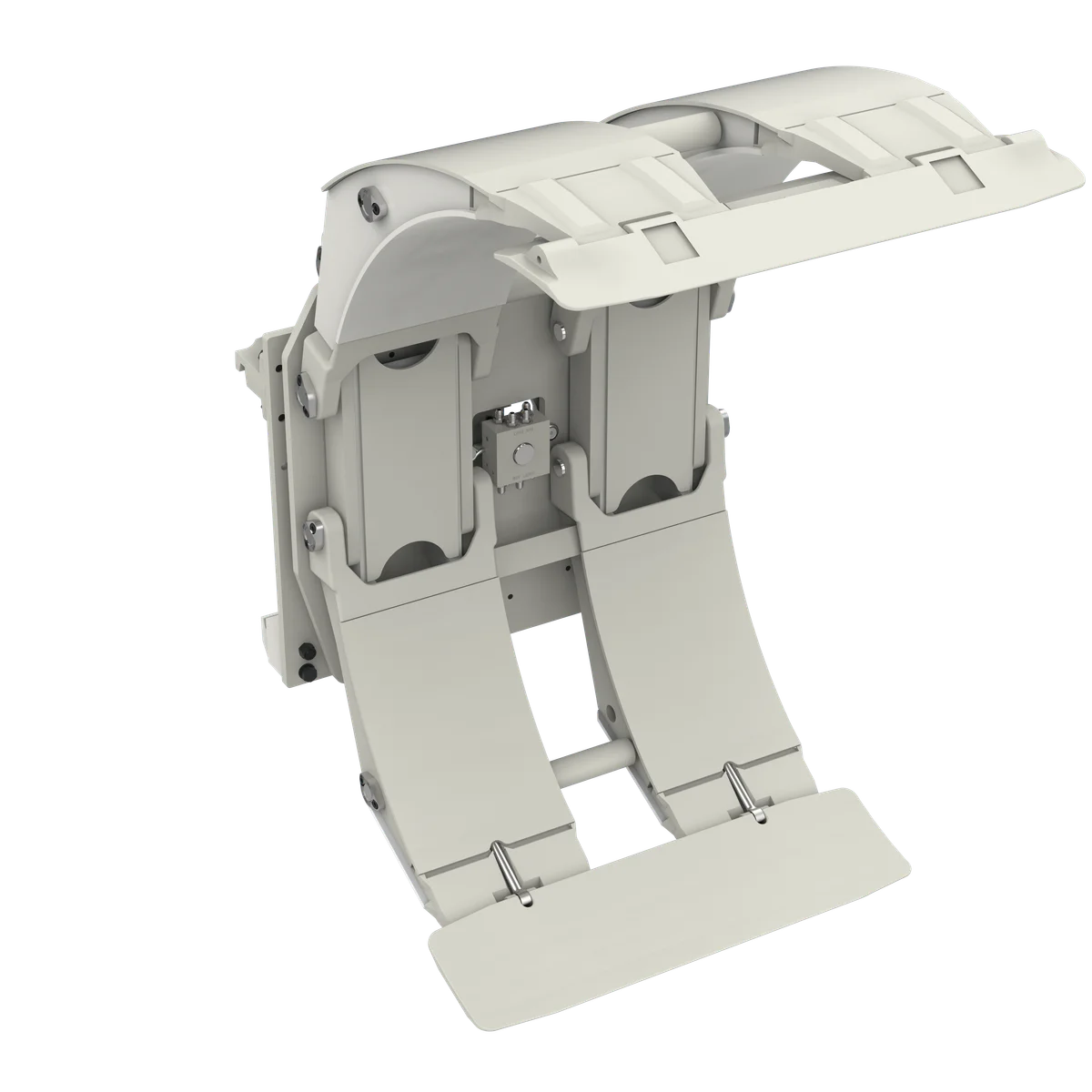
Some mill and converting operations need the roll standing on its end — for a printing press infeed, for a specific storage pattern, or for a customer who takes vertical rolls. A roll upender adds a tilt function to the clamp so the same truck can rotate and then place the roll horizontally or vertically.
The WONTONNE Roll Upender is rated up to 3500 kg with a 250–1520 mm roll range, and it is built on a simple, lightweight structure to keep the attachment's own weight under control. Because it combines rotation and tilt in one attachment, it removes a separate handling step — and every removed step is a removed chance of damage.
What to check before specifying
- Confirm the roll diameter range and the maximum roll weight, including any moisture pickup.
- Confirm the load centre at which the truck must remain stable with the attachment fitted.
- Match the mounting class to the truck — ISO 2A, 3A or 4A depending on the model.
- Check aisle width and stack height against the attachment's effective thickness.
- Decide whether the roll population is consistent enough for a fixed arm or needs a positioned arm.
If you are replacing a fleet or adding a second handling line, the wider range of forklift attachments covers the rest of the mill's material handling needs beyond rolls.
Buying roll handling equipment: new, used or re-equipped
Search interest in paper mill machinery for sale is often driven by mills that are re-equipping rather than building. In that situation the attachment is usually the fastest and lowest-risk upgrade: it mounts on trucks the mill already owns, it is compatible with major forklift brands, and it changes the handling process without touching the paper machine.
When comparing suppliers, ask for the model-level specification rather than a single capacity figure. A clamp is defined by its capacity, load centre, roll range, mounting class, arm type and effective thickness together — a 2000 kg clamp with a 650 mm load centre is a different tool from a 2000 kg clamp at 800 mm. WONTONNE publishes these figures per model number so the attachment can be matched to the truck and the roll population before the order is placed, and provides technical support and spare parts after it.
Roll handling is the last chance to protect the value already created in the paper machine. Specify it with the same care as the winder.
Frequently asked questions
What does a paper roll clamp do that forks cannot?
Forks require a pallet or a sling and cannot rotate a roll. A paper roll clamp grips the curved surface directly, holds the roll under hydraulic pressure and rotates it 360 degrees left or right, so the roll can be picked from the winder, turned and placed in a container or warehouse position without a pallet and without manual handling.
How do I choose between a fixed arm and a positioned arm clamp?
Fixed short arm clamps are simpler and give good visibility, and they work well when the mill handles a consistent roll diameter. Positioned short arm clamps adjust the arm to the roll width, which suits mills and converters running a mixed roll population across several paper grades and diameters.
Can a paper roll clamp be fitted to the forklifts we already own?
WONTONNE paper roll clamps are compatible with major forklift brands and are supplied in different mounting classes, including ISO 2A, 3A and 4A depending on the model. The correct mounting class, capacity and load centre must be confirmed against the truck's rated capacity before fitting, because an attachment moves the load centre forward and reduces the effective capacity of the truck.
Next step
If roll damage, pallet cost or loading-bay cycle time is showing up in your conversion cost, the fix is usually a specification problem rather than a truck problem. Send WONTONNE your roll diameter range, maximum roll weight and the forklift models in service, and we will match a paper roll clamp or roll upender to the job. Contact WONTONNE to start the specification.