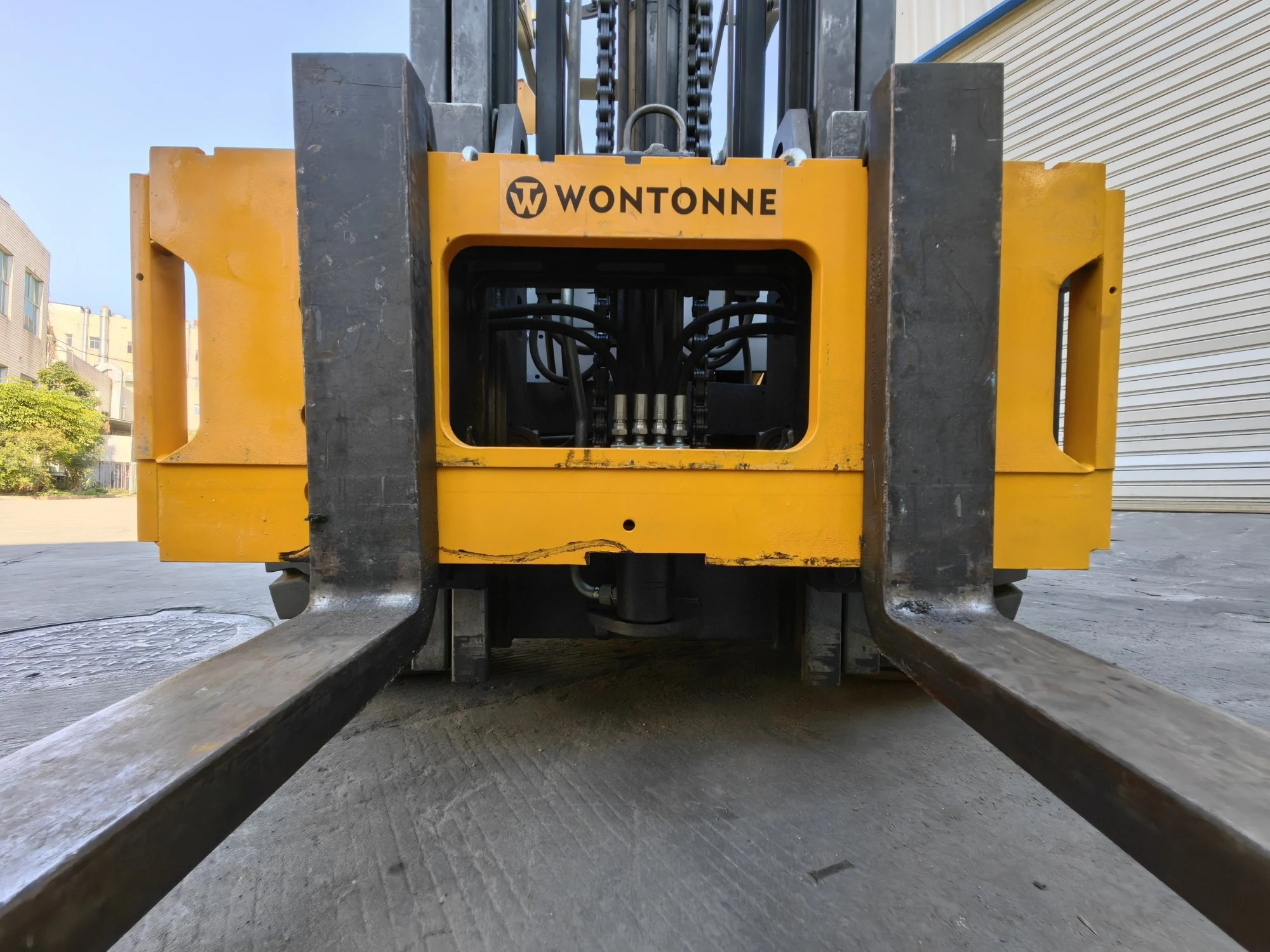

In material handling, a rotator is a forklift attachment that turns the load on the fork carriage instead of turning the truck. The mast stays square to the aisle, the forks stay level, and the load rotates about a horizontal or vertical axis depending on the attachment type. That distinction matters: it is the reason rotators can empty a tote, invert a box of fruit, or swing a long load through a doorway without the operator repositioning the whole machine.
This guide covers the rotator family as it is actually used in warehouses, food processing and agriculture — what each type does, how load security changes with rotation, and how to size a unit against a real load. For the full attachment range, see all forklift attachments.
What a Rotator Does That a Mast Cannot
A standard forklift can raise, lower, tilt and side-shift. None of those functions change the orientation of the load relative to the horizon. A rotator adds that fifth degree of freedom. Once the load can be turned independently, several jobs that used to need manual handling or a dedicated tipper become a single lift:
- Emptying and dumping. Totes, bins and boxes can be tipped to discharge contents at a controlled point.
- Inverting. A loaded container can be turned over to release material that will not flow out on its own.
- Re-orienting. Pallets, drums or long goods can be turned to suit the next process step or the receiving rack.
- Reducing handling. One attachment replaces a lift, a set-down, a manual turn and a second lift.
The trade-off is always the same: the attachment and its hydraulic function add weight and, in most designs, some lost capacity at the load centre. Sizing is therefore the central engineering question, not a detail to settle after purchase.
Types of Rotators and Where Each Fits
Rotators are not one product. They are a family distinguished by the axis of rotation, the mechanism that grips the load, and the amount of rotation available.
Fork rotators and turnaforks
Fork rotators turn the forks themselves, usually about a longitudinal axis, so a load sitting on the forks can be rolled or tipped. Turnaforks are the close relative used where the load must be rotated through a specific angle for presentation or transfer. These are the general-purpose units — useful wherever the load is stable on the forks and the rotation is modest.
Box rotators
Box rotators are built for containerised loads. Instead of relying on gravity to keep the box on the forks, they clamp or stabilise the box so it can be rotated to a much greater angle without slipping. This is the category that handles dumping duty in fruit packing, food processing and general sundries handling, where a box has to be turned far enough to empty completely.
Turnaloads and multiple load handlers
Where a single pallet is not the unit of work, turnaloads and multiple load handlers combine rotation with the ability to carry more than one load at a time. They suit high-throughput movement between production and storage, where the attachment's job is as much about throughput as about orientation.
Load Security Is the Real Design Problem
Anyone can build a mechanism that turns. The engineering difficulty is keeping the load attached while it turns, and that is where rotator designs diverge most sharply.
On a simple fork rotator, the load is held only by gravity and friction. That is acceptable for a compact, rigid, evenly stacked load rotated through a small angle. It is not acceptable for a full box of loose fruit being turned to dump position, because the centre of gravity moves outside the fork footprint as the angle increases.
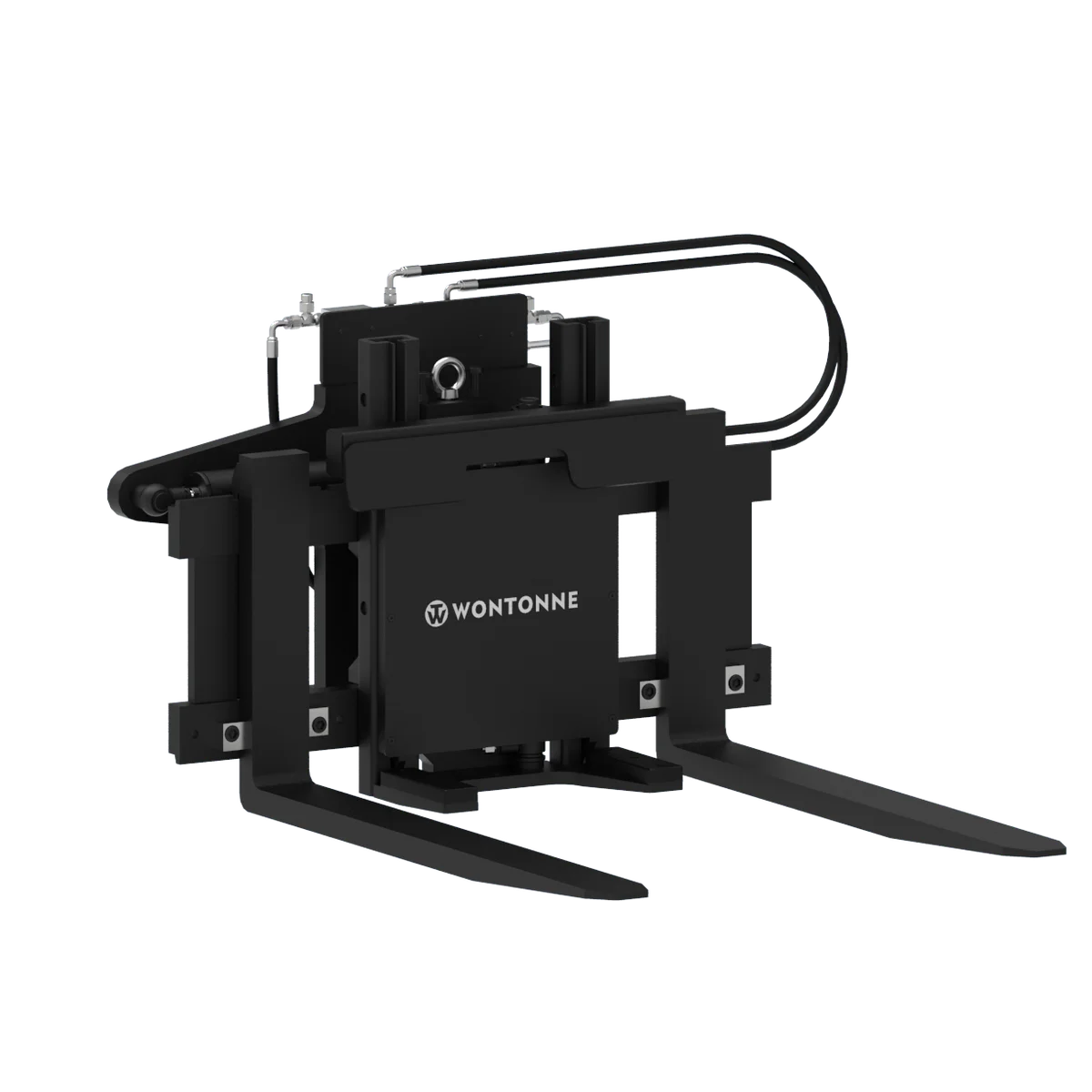
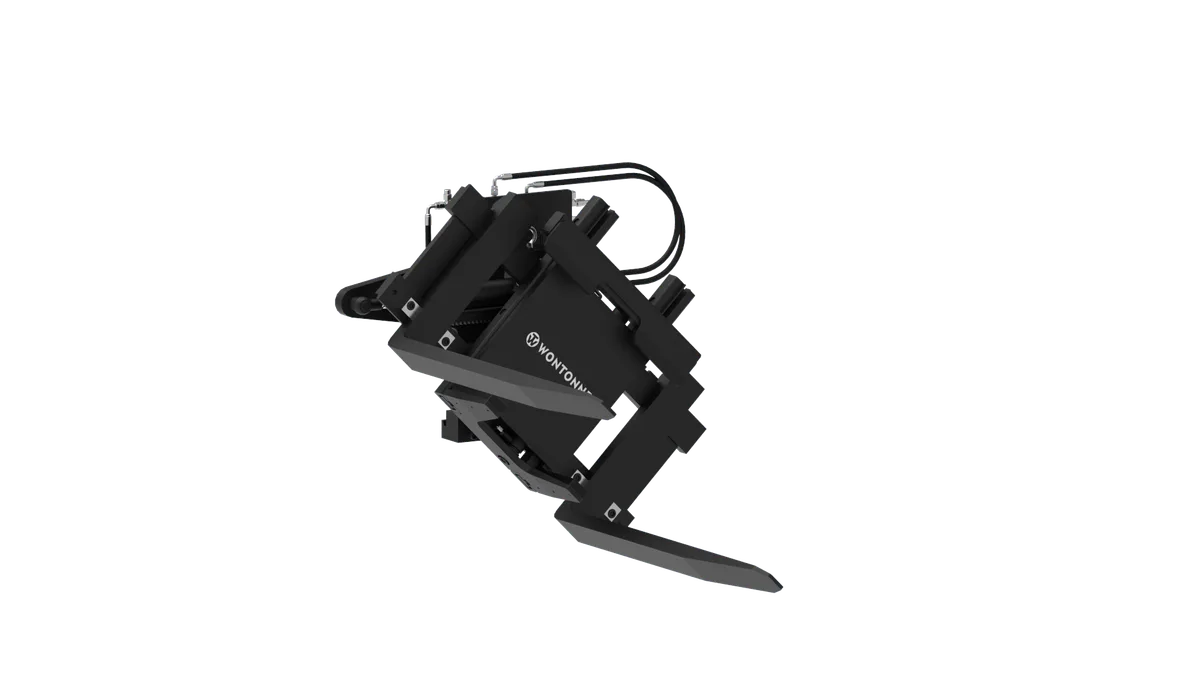
Stabilised designs solve this by adding a mechanical arm and a hydraulic stabiliser that grips the box before rotation begins. The arm carries the load through the arc rather than letting it hang on the fork tips. In practice this changes three things:
- The box cannot slide off the forks mid-rotation.
- Rotation can proceed to a full dumping angle rather than stopping at the point of instability.
- The discharge point is controlled, so material lands where it is wanted instead of spreading.
For dumping duty, a stabilised arm is not an upgrade — it is the difference between a workable process and a recurring spill.
Sizing a Rotator: What to Check Before You Buy
Rotator selection is a capacity calculation, not a catalogue match. Work through these points in order.
- Rated capacity and load centre. Attachment ratings are quoted at a stated load centre. A load whose centre of gravity sits further out reduces the usable capacity.
- Attachment weight. The rotator's own mass is subtracted from the truck's residual capacity. A heavier unit is not automatically stronger for your application — it may simply leave you unable to lift the load.
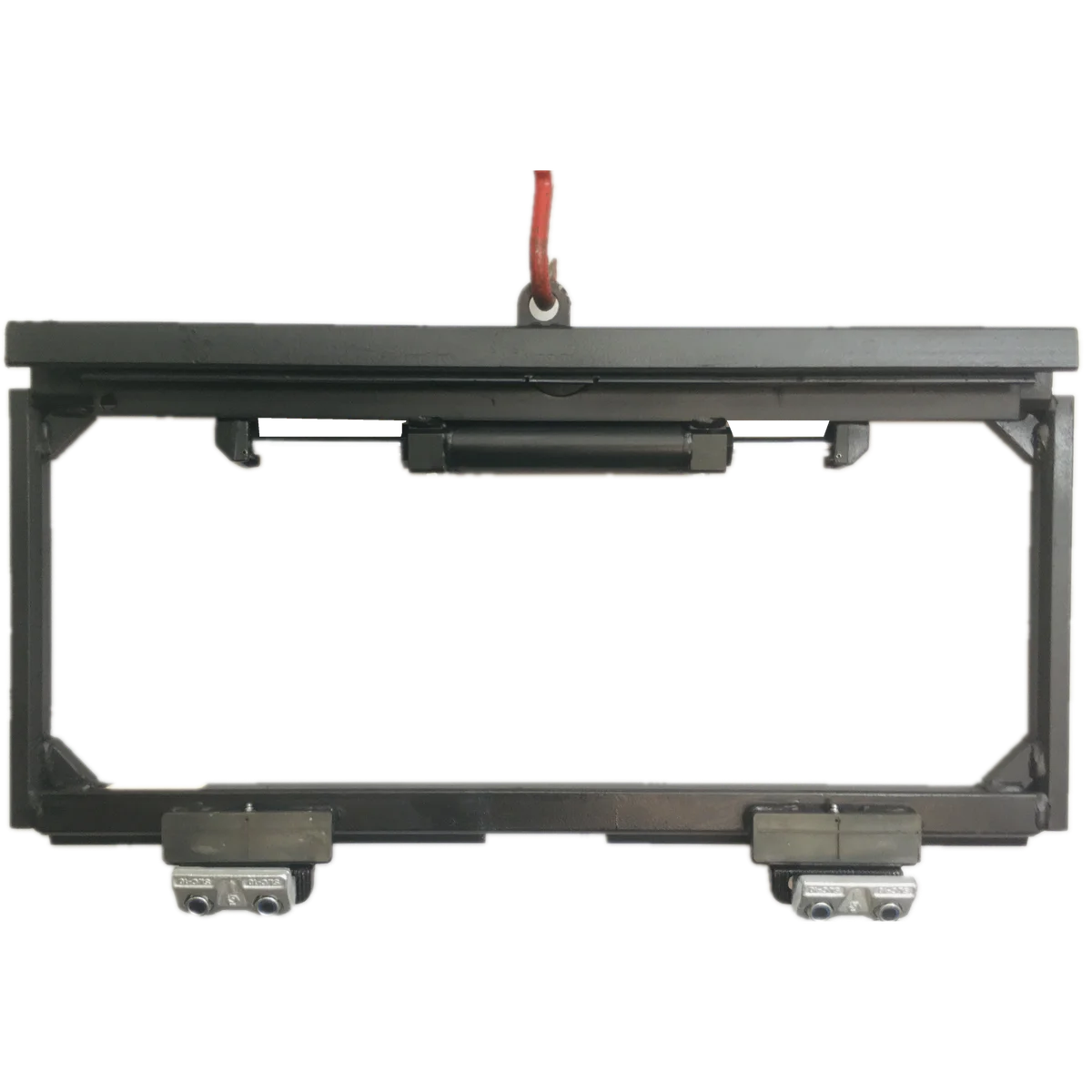
- Mounting class. The attachment must match the carriage class of the truck it will run on. Mounting a unit on the wrong class is a fit and safety problem, not an inconvenience.
- Effective thickness. This is how far the attachment pushes the load forward of the carriage. It affects both the load centre and the truck's remaining capacity.
- Rotation range and arm type. Match the available rotation to the task. Dumping needs far more range than re-orienting.
- Hydraulic supply. Confirm the truck has the function and flow the attachment needs before committing.
A worked example makes the point. The 180° Box Rotator (Stabilized Arm Type) is offered in three models — BRB15A-940A at 1500 kg, BRB25A-1040A at 2500 kg and BRB30A-1100B at 3000 kg, all rated at a 500 mm load centre. The two smaller models mount on ISO 2A carriages and the largest on ISO 3A. Attachment weights run from 186 kg to 326 kg, and effective thickness from 160 mm to 181 mm. Those figures are exactly the ones that must be subtracted from the truck's capacity before you decide whether the combination lifts your box.
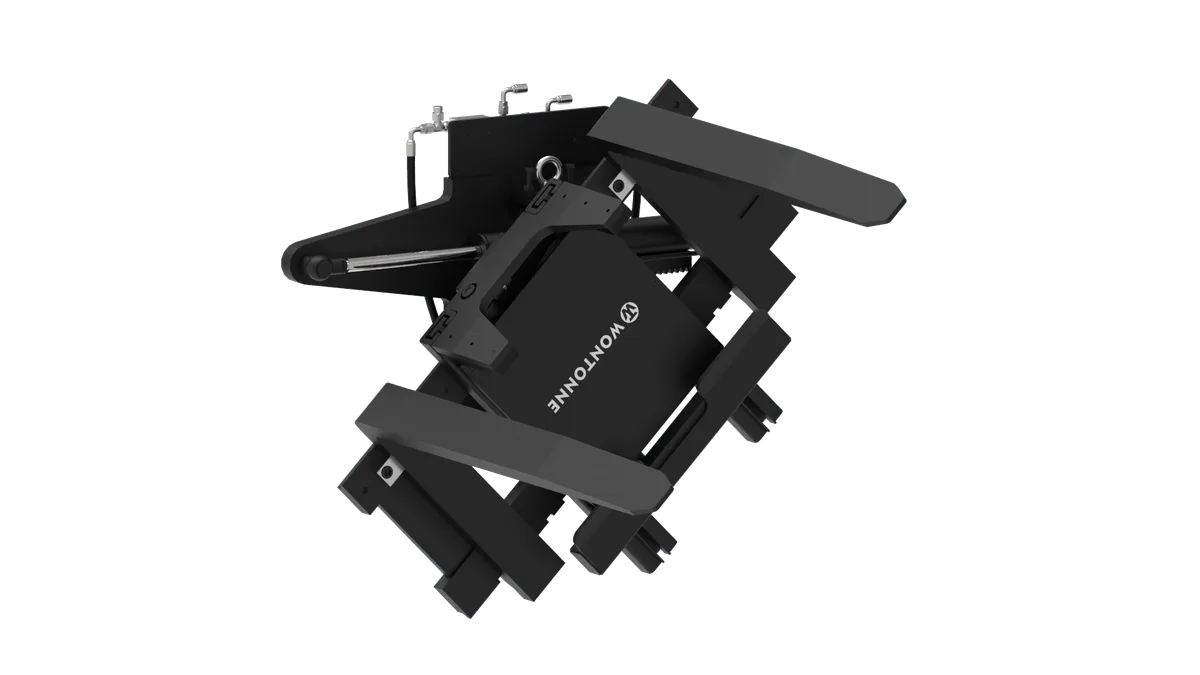
Comparison: Rotator Types at a Glance
| Type | Typical duty | How the load is held | Rotation range |
|---|---|---|---|
| Fork rotator | Re-orienting, light tipping | Gravity and friction on the forks | Modest, load-dependent |
| Turnaforks | Presentation and transfer | Forks, load must stay stable | Set angles for the process |
| Box rotator | Dumping and emptying | Clamp or stabilised arm | Full dumping angle |
| Box rotator, stabilised arm | Dumping fruit, food, sundries | Arm plus hydraulic stabiliser | 180° operation |
| Turnaloads / multiple load handlers | Multi-load throughput | Purpose-built load retention | Application-specific |
The pattern is consistent: the further the load rotates, the more the attachment must do to hold it. Choose the type by the angle you actually need, then size the model by capacity, weight and mounting class.
Operating and Maintenance Notes
Rotators are hydraulic attachments, and most field problems trace back to the same few causes. Keep the following in mind:
- Cycle the attachment through its full range empty before the first loaded lift, and after any hose or coupling work.
- Inspect arms, clamps and pivot points for wear — these parts carry the load through the arc and are the first to show fatigue.
- Keep the hydraulic supply clean; contamination affects rotation control long before it affects lift.
- Re-check capacity whenever the truck or the attachment changes. A rotator moved to a smaller truck does not carry its original rating.
WONTONNE has been manufacturing forklift attachments and material handling equipment for more than 20 years, with export supply to customers worldwide and after-sales support covering technical advice and spare parts.
FAQ
What is the difference between a forklift rotator and a box rotator?
A forklift rotator turns the load using the forks, relying on gravity and friction to keep it in place. A box rotator adds a clamp or a stabilised arm that grips the box, so it can be rotated much further — typically to a full dumping position — without the load sliding off.
How do I know which rotator capacity I need?
Start with the weight of the load and the position of its centre of gravity, then subtract the attachment's own weight and account for the effective thickness that pushes the load forward. The residual figure must cover your load at its real load centre. Ratings are always quoted at a stated load centre, so a rating alone is not enough.
Can a rotator be fitted to any forklift?
It depends on the carriage mounting class and the truck's hydraulic supply. The attachment must match the carriage class, and the truck must provide the hydraulic function the rotator needs. Capacity also has to be re-checked for the specific truck, because the attachment weight reduces what the truck can lift.
Next Step
If you are emptying boxes, inverting containers or re-orienting loads at the fork carriage, the right rotator will remove a handling step from every cycle. Tell us your load weight, its load centre, your carriage class and the rotation you need, and we will confirm the model that fits. Contact WONTONNE to discuss your application, or review the full attachment range first.