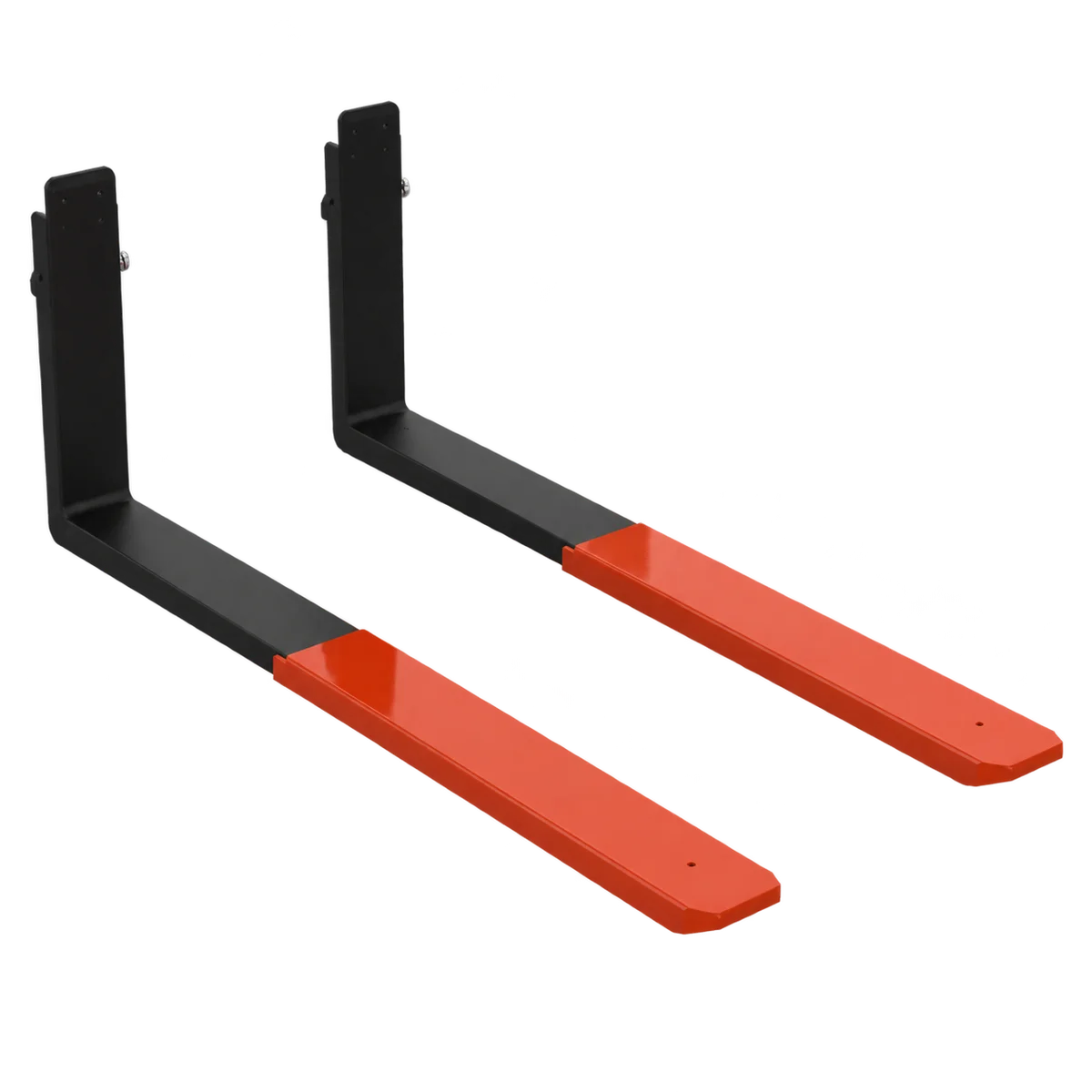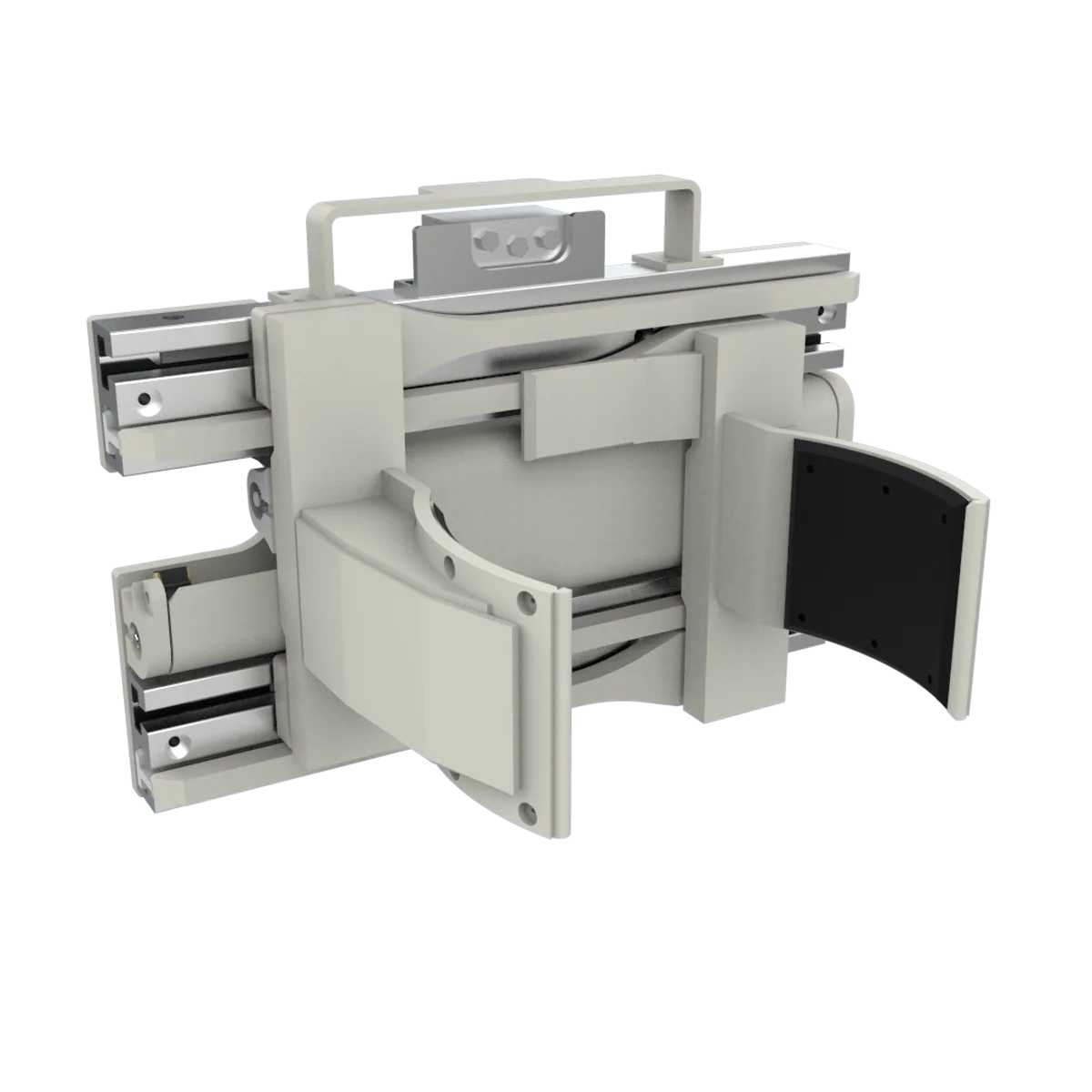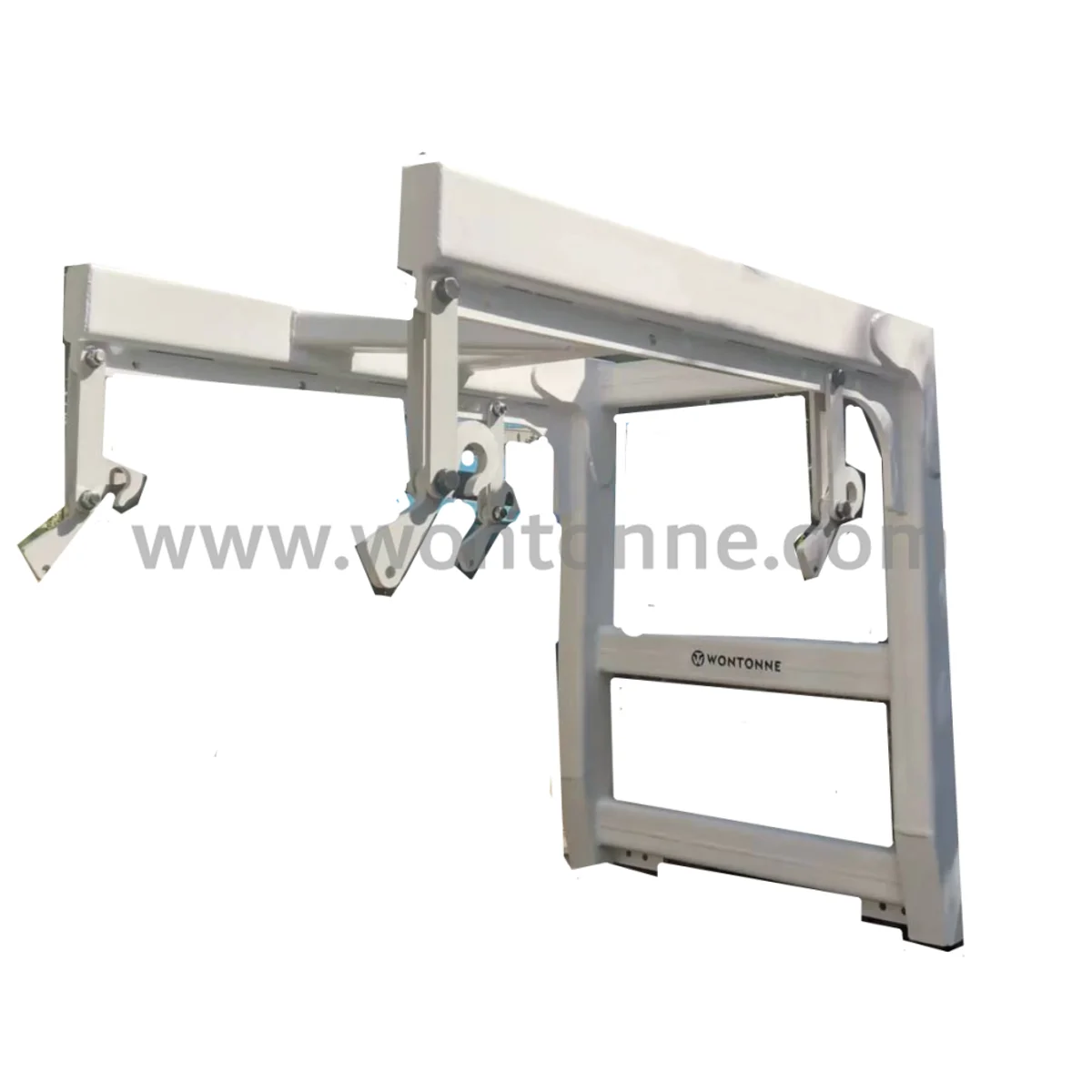

A drum lifter is the piece of equipment that stands between a full 205 L drum and the people working around it. In most plants the drum itself is not the problem — the problem is that it has to be picked up, moved across a yard, stacked two or three high, and sometimes tipped to empty. Doing that by hand or with improvised slings is where injuries and product losses come from. A purpose-built drum lifter, whether it is a forklift-mounted drum lifter clamp or a wheeled drum lifter trolley, gives the drum a controlled, repeatable grip and keeps the operator out of the crush zone.
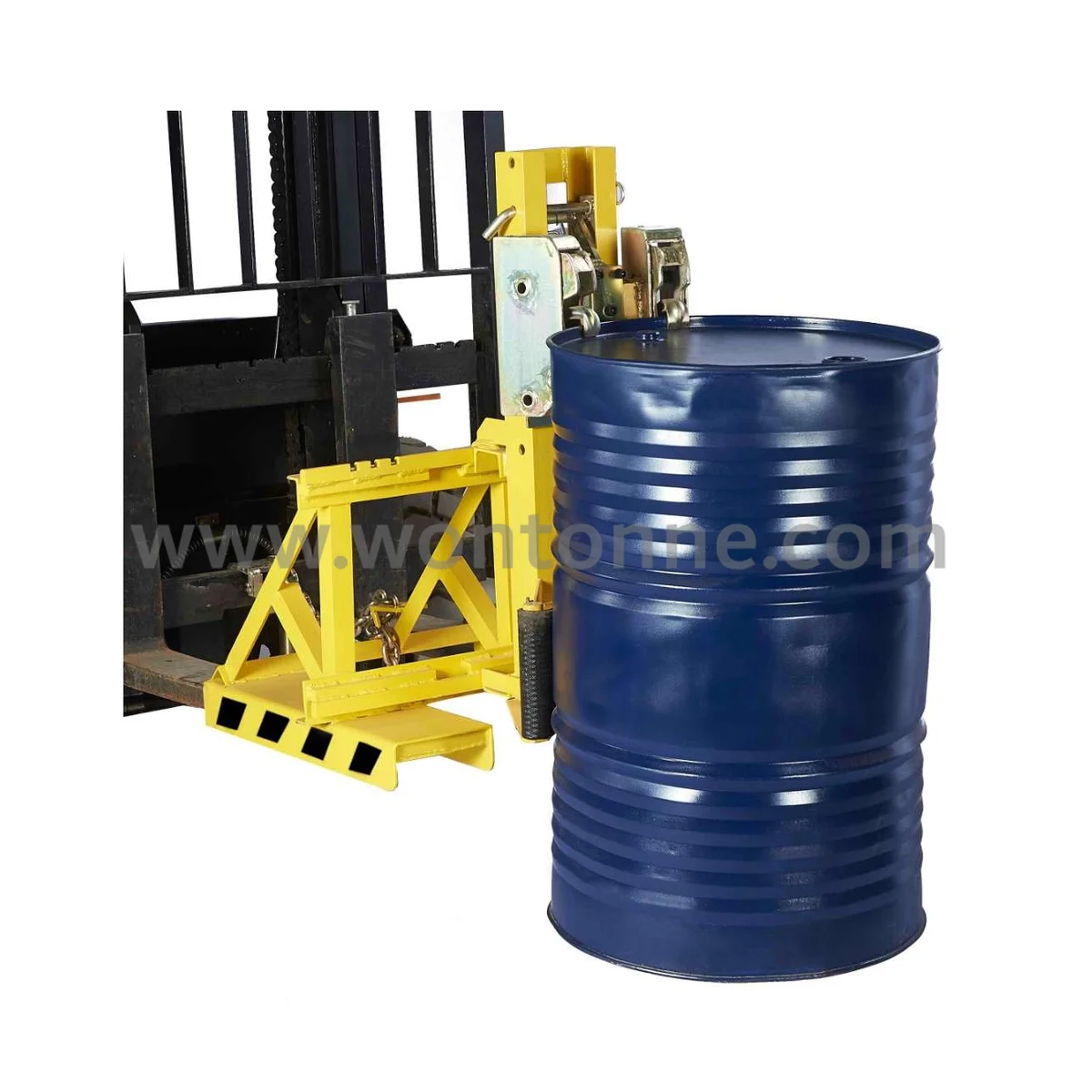
This guide covers the main families of drum lifters, the questions that decide which one fits your operation, and the specification points that are most often overlooked when buyers compare models.
What a drum lifter actually does
Every drum lifter solves the same three problems: gripping a cylindrical, often slippery container; carrying it without tipping; and releasing it cleanly at the destination. The differences between products come down to how the grip is generated and how much of the handling cycle is powered.
Mechanical drum lifters use the forklift's own hydraulic mast and carriage movement to close the clamp. The operator drives the carriage forward or lifts against a linkage, the clamp arms close on the drum, and a mechanical lock holds the grip. Hydraulic drum lifters add a hydraulic circuit — either from the forklift's auxiliary valve or a self-contained unit — to open and close the arms or to tilt the drum. Manual drum lifters and drum lifter trolleys rely on the operator for the lifting effort, usually through a lever, ratchet or pump handle, and are intended for short moves at floor level rather than racking.
Grip points: why drum type matters first
Before capacity, decide what the clamp is allowed to touch. Steel drums can be gripped on the body or the rolling hoops. Plastic drums deform under point loads and need a wider, rubber-faced contact area. Fibre drums are the least tolerant of all. A drum lifter clamp that is excellent on a reinforced steel drum can crush a thin-wall plastic container, so the contact design — not the tonnage figure — is the first thing to verify.
Mechanical drum clamps for forklifts
Mechanical clamps are the workhorse of drum logistics because they add no hydraulic plumbing and no extra maintenance points. WONTONNE builds two families for this duty.
The HDL Series Mechanical Drum Clamp uses a double chuck design — a configuration developed from USA technology — that picks up plastic and steel drums easily and holds them with a rubber contact surface to prevent friction damage. It is a heavy duty design intended for long service, and it copes with uneven ground conditions better than a rigid single-point clamp. The series runs from the WT-1HDL at 900 kg through WT-2HDL at 1800 kg and WT-3HDL at 2700 kg up to the WT-4HDL at 3600 kg, all at a 1500 mm load centre, so the same attachment family covers everything from a single light drum to multi-drum handling on a larger counterbalance truck.
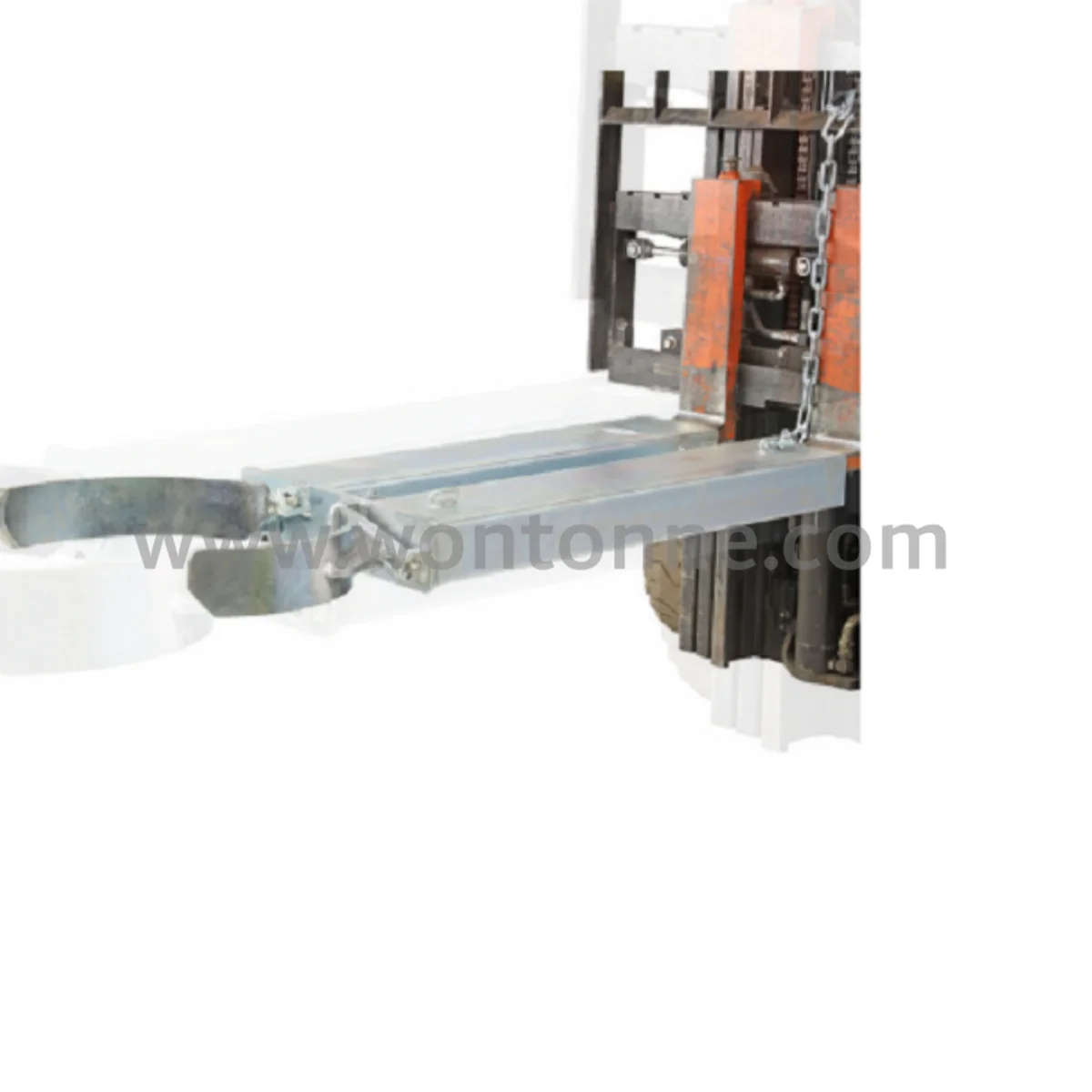
The DL Series Mechanical Drum Clamp is the standard 205 L drum specialist. Its fully automatic clamping action means the operator stays seated through the whole cycle: the clamp grips the drum around the rolling hoop, and release is a simple matter of lowering and reversing. It is locked to the carriage by chain or bolts. Two models are available, DL1 at 500 kg and DL2 at 1000 kg, both at a 1340 mm load centre.
- Choose the DL Series when you handle standard 205 L drums on a regular route and want the simplest possible cycle.
- Choose the HDL Series when drum weights vary widely, when plastic and steel drums are mixed, or when ground conditions are uneven.
- Check the load centre before ordering — a clamp rated at 1500 mm load centre reduces the truck's residual capacity by a different amount than one rated at 630 mm.
Drum lifter and tilter: when you need to pour
Moving a drum and emptying it are two different jobs, and mixing them up is a common and expensive mistake. If the drum has to be tipped to dispense its contents, a plain clamp will not do it — you need a drum lifter and tilter.
The Drum Clamp (Tipping Type) picks up, transports and puts away cylindrical drums and adds up to 90° of hydraulic tilting for controlled pouring. It mounts onto existing forks, assembles and connects simply, is hydraulically connected to the forklift, and is designed to preserve good visibility from the seat. Capacity is up to 1000 kg, with the DTB20D-001A on ISO2A carriage and the DTB20D-001B on ISO3A. The roll range of 450–1730 mm lets it take a spread of drum diameters rather than a single size.
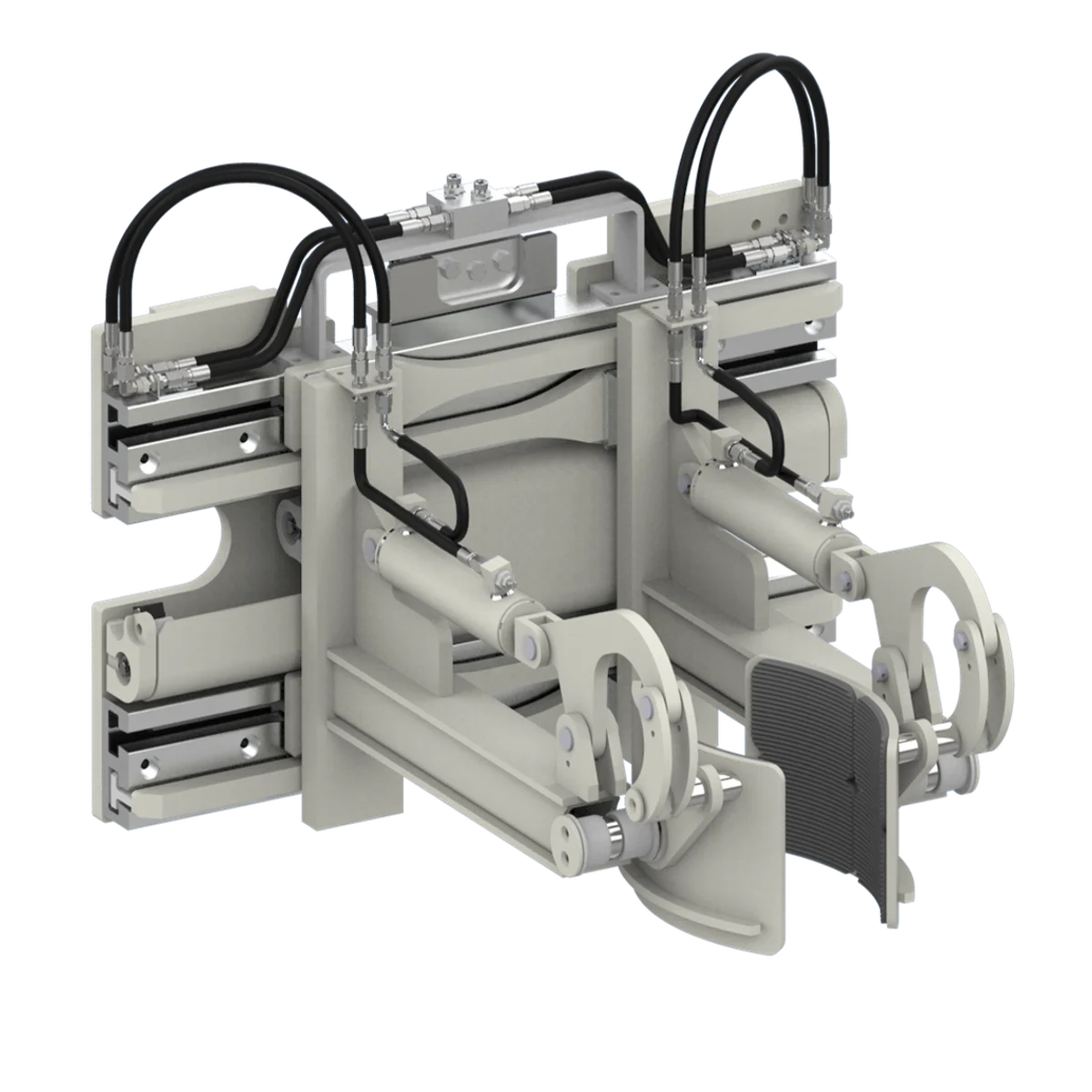
For operations that need throughput rather than pouring, the multi-drum clamps are the better answer. The 2 Drum Clamp (Side Shifting / Revolving) carries, stacks and rotates two drums at a time without pallets, with rubber-vulcanized clamp arms and side shifting plus revolving functions; it is widely used in oil, petrochemical and food industries and is rated up to 1900 kg. The 4 Drum Clamp (Side Shifting / Revolving) does the same for four drums at up to 1600 kg, which is the usual choice for high-volume drum logistics where pallets would otherwise be the bottleneck.
Where drums are taller than standard, the heightening variants exist for exactly that reason: the 2 Drum Clamp Heightening Type and the 4 Drum Clamp Heightening Type raise the arm height while keeping side shifting and revolving, and are again aimed at oil and chemical applications.
Comparing drum lifter types
The table below maps the main options against the duty they suit. Capacities and load centres are taken directly from the WONTONNE product range.
| Type | Typical models | Capacity | Load centre | Best for |
|---|---|---|---|---|
| Mechanical drum clamp, 205 L | DL1, DL2 | 500–1000 kg | 1340 mm | Standard 205 L drums, seated automatic cycle |
| Mechanical drum clamp, heavy duty | WT-1HDL to WT-4HDL | 900–3600 kg | 1500 mm | Mixed steel and plastic drums, uneven ground |
| Hydraulic tipping clamp | DTB20D-001A / 001B | Up to 1000 kg | 630 mm | Controlled pouring up to 90° |
| 2-drum revolving clamp | DTS20D-003A, DTR20D-004A | Up to 1900 kg | 300 mm | Pallet-free stacking, two drums per cycle |
| 4-drum revolving clamp | DFS20D-007A, DFR20D-008A | Up to 1600 kg | 600 mm | High-volume drum logistics, four drums per cycle |
Reading the load centre column
A drum clamp carries its load further forward than a standard fork carriage, and that distance is what the load centre figure describes. The 2-drum and 4-drum clamps sit at 300 mm and 600 mm respectively, the tipping clamp at 630 mm, and the mechanical clamps at 1340–1500 mm. The further forward the load centre, the more the truck's residual capacity is reduced. Always compare the attachment's rated capacity with the truck's derated capacity at that load centre, not with the truck's headline capacity on the data plate.
Choosing between a forklift attachment and a drum lifter trolley
Not every drum move justifies a forklift. A drum lifter trolley — sometimes called a manual drum lifter — is the right tool when drums travel short distances on a level floor, when the volume is low, or when a forklift cannot reach the area. The trade-off is throughput and lift height: a trolley moves one drum at a time and rarely stacks.
A forklift drum lifter attachment wins whenever drums need to be stacked, racked, loaded onto vehicles or moved outdoors over uneven ground. The same attachment also removes the manual handling risk entirely, because the operator never leaves the seat for the DL Series cycle.
For overhead lifting, chain drum lifters and below-hook units are a separate category again, used with a crane or hoist rather than a forklift. They are worth considering where a crane already serves the area and the drum only needs to be raised and lowered vertically.
Frequently asked questions
Can one drum lifter handle both steel and plastic drums?
Yes, provided the contact design suits both. The HDL Series Mechanical Drum Clamp is specified for plastic and steel drums and uses a rubber contact surface to prevent friction damage, with a double chuck design for easy pick-up. A clamp intended only for steel drums may mark or deform plastic containers, so confirm the drum materials with the supplier before ordering.
What capacity do I need for a 55 gallon drum lifter?
A 55 gallon drum is the same 205 L container used across most industries, and a full drum of a dense product is heavy — so the attachment rating must cover the full gross weight, not the empty drum. The DL Series covers 500 kg and 1000 kg at a 1340 mm load centre, while the HDL Series extends from 900 kg to 3600 kg at 1500 mm. If you handle several drums per cycle, the 2-drum clamp at up to 1900 kg and the 4-drum clamp at up to 1600 kg are the relevant figures.
How is a drum lifter attached to the forklift?
Mechanical clamps such as the DL Series are locked to the carriage by chain or bolts. The tipping clamp mounts onto existing forks and connects hydraulically to the forklift, and the multi-drum clamps are supplied on ISO2A carriages. All WONTONNE drum handling attachments are compatible with major forklift brands, and the mounting class and effective thickness are listed per model so you can match them to your carriage.
Next step
Drum handling goes wrong when the attachment is chosen on price or tonnage alone. Match the grip design to the drum material, check the load centre against your truck's residual capacity, and decide early whether the job needs lifting, stacking or pouring — those three answers point to a specific product family. WONTONNE has been manufacturing forklift attachments and material handling equipment for more than 20 years, with technical support and spare parts behind every unit. Review the full range on our all forklift attachments page, or contact WONTONNE with your drum type, weight and truck model and we will confirm the right drum lifter for the application.