
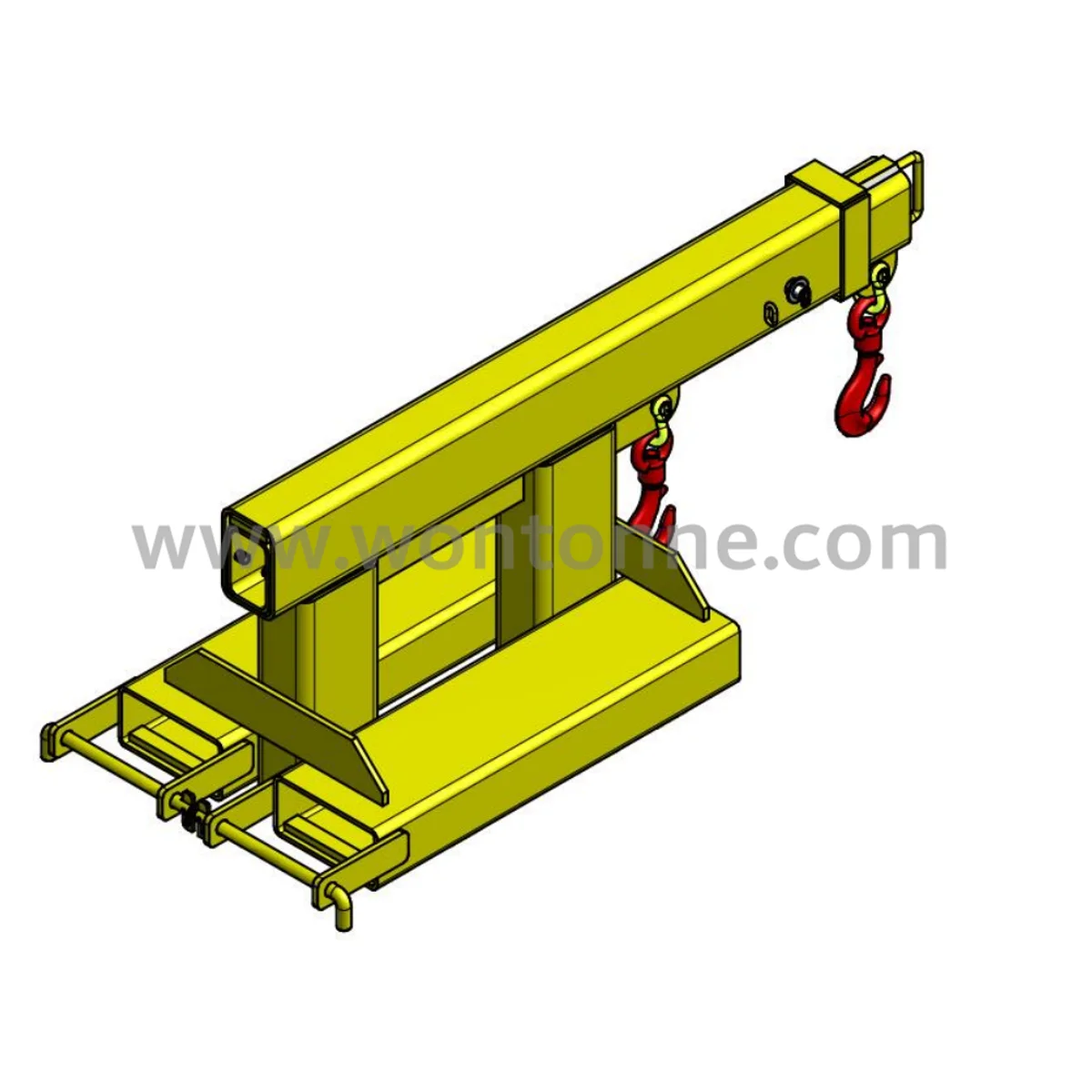
Jib cranes are lifting devices built around a horizontal arm — the jib — that extends from a vertical support or, in the forklift-mounted version, from the fork carriage itself. On a forklift, that arm converts the truck into a machine that can reach over obstructions, into truck beds, or past the front wheels to place a load where a bare fork cannot. WONTONNE has manufactured jib cranes and material handling equipment for more than 20 years, and this guide explains the designs we build, how capacity behaves as the arm extends, and what to check before you specify a unit.
What jib cranes do that a bare forklift cannot
A standard forklift lifts straight up and down at the carriage. That is fine when the load sits in open floor space, but it becomes awkward when the load is behind a wall of pallets, inside a container, under an overhang, or on the far side of a machine base. A jib crane shifts the lifting point forward and, on telescopic models, adds reach on demand.
The trade-off is mechanical: every millimetre of forward reach increases the turning moment on the carriage, so the attachment itself has to be engineered for the load it carries. That is why a jib crane is specified by capacity and load center rather than by a single tonnage figure.
Types of jib cranes for forklifts
Telescopic jib cranes
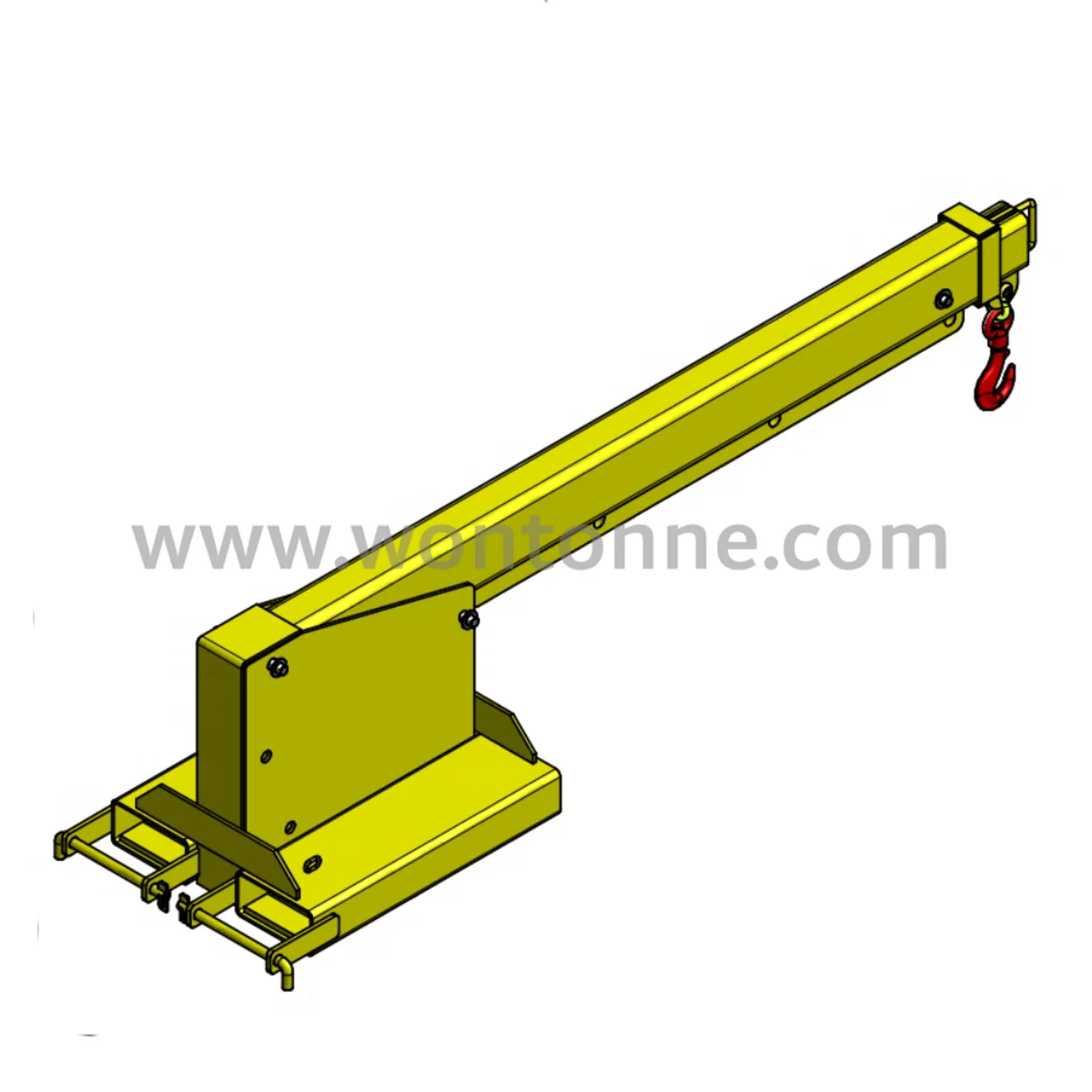
Telescopic jib cranes extend their length to lift goods, which makes them useful when the required reach changes from job to job. WONTONNE builds two families in this style.
- FJ Series Telescopic Forklift Jib Crane — telescopic extension for lifting, painting or electric galvanized surface treatment, and capacity up to 2000 kg. The listed model FJC20-001A carries a 600 mm load center, an ISO 2A mounting class, a 1000–1800 mm roll range, a 100 mm effective thickness and a 190 kg attachment weight.
- TJ Series Telescopic Forklift Jib Crane — telescopic extension and angle change, so the arm can be repositioned as well as lengthened. Capacity runs up to 3000 kg. The listed model TJC30-001A uses a 600 mm load center, an ISO 3A mounting class, a 1000–2000 mm roll range, a 120 mm effective thickness and a 250 kg attachment weight.
Hook-on jib cranes
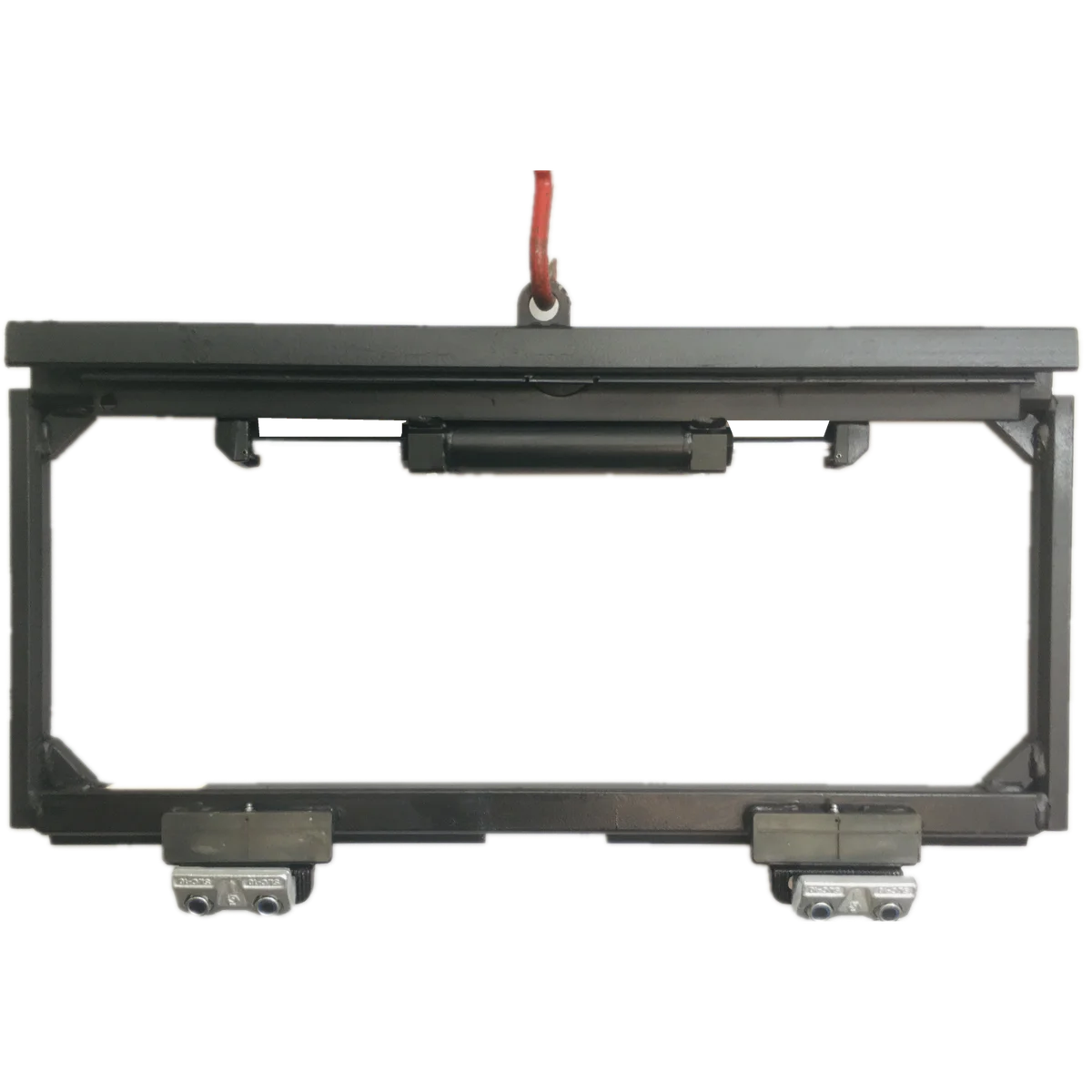
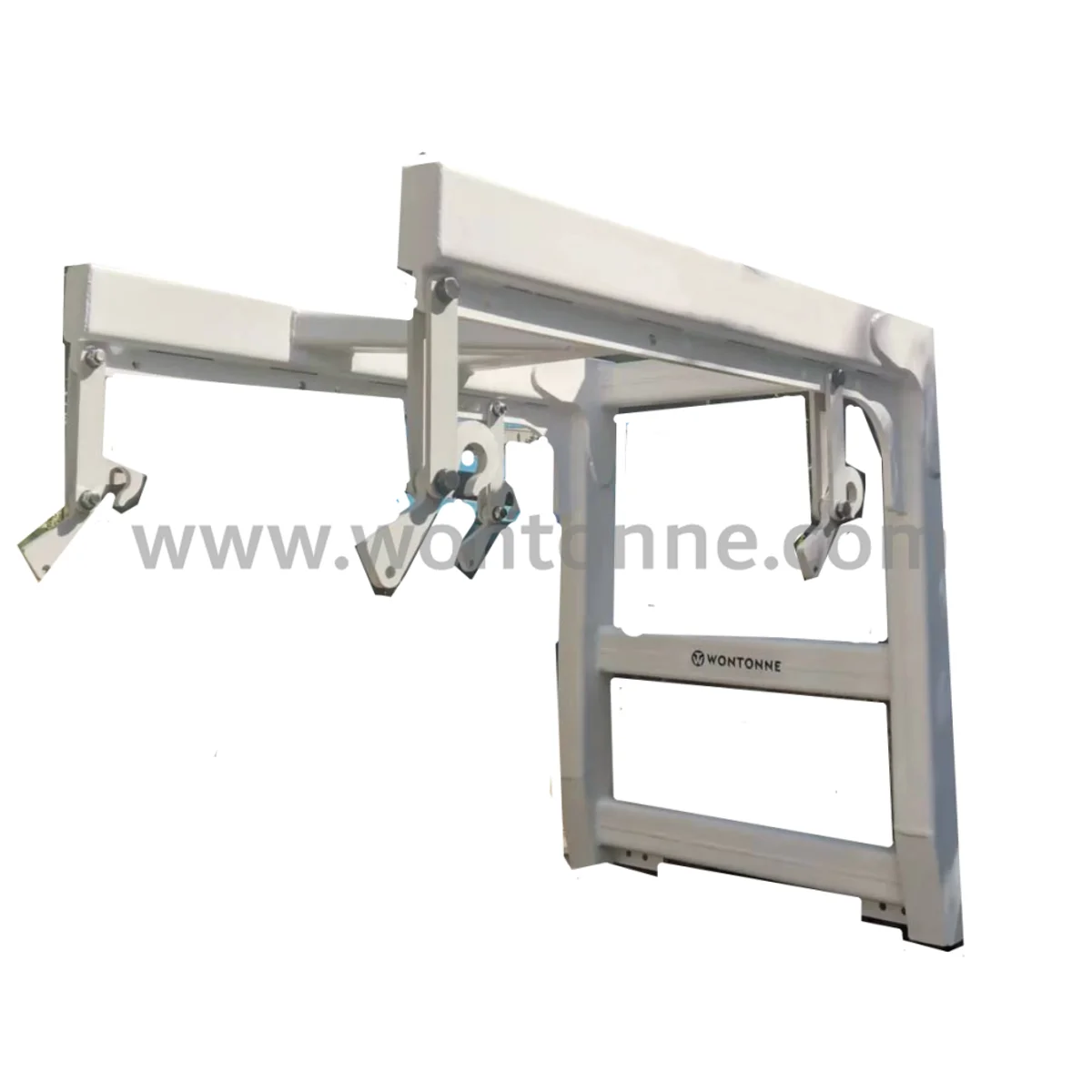
The DB Series Jib Crane hooks onto the fork carriage rather than sitting on the fork tines. WONTONNE designed it with a short effective thickness so that less of the truck's rated capacity is consumed by the attachment, and with 4 hoist hooks for safe lifting. Capacity runs up to 3000 kg. Two models are listed, DBS30D-1515B at 352 kg and DBS30D-1416B at 357 kg, both in ISO 3A mounting class.
The distinction matters in practice. A slip-on crane sits on the forks and pushes the load further forward, which costs capacity. A hook-on design keeps the load closer to the carriage and spreads the lift across four hook points.
Comparing the WONTONNE jib crane range
| Series | Mounting | Capacity | Mounting class | Notable feature |
|---|---|---|---|---|
| FJ Series Telescopic | Fork carriage | Up to 2000 kg | ISO 2A | Telescopic extension, 1000–1800 mm roll range |
| TJ Series Telescopic | Fork carriage | Up to 3000 kg | ISO 3A | Telescopic extension and angle change, 1000–2000 mm roll range |
| DB Series | Hooks onto fork carriage | Up to 3000 kg | ISO 3A | Short effective thickness, 4 hoist hooks |
All three series are compatible with major forklift brands, and WONTONNE supplies technical support and spare parts as part of its after-sales service.
Why load center changes everything
A forklift's data plate rating assumes the load sits at a defined load center, usually 500 mm or 600 mm from the carriage face. Move the load forward — which is exactly what a jib crane does — and the effective capacity falls. This is the single most misunderstood point in jib crane selection.
Two consequences follow:
- Match the jib's load center to the truck's rating. The FJ and TJ models listed above are specified at a 600 mm load center, so the calculation starts from a known reference rather than an estimate.
- Subtract the attachment weight. The jib crane itself is a load on the carriage — 190 kg for the FJC20-001A, 250 kg for the TJC30-001A, and around 350 kg for the DB Series models. That weight comes off the top before any cargo is lifted.
Where a truck is rated at a lower load center than the jib requires, the practical answer is usually a larger truck or a shorter-reach attachment, not a lighter load on paper.
How to choose the right jib crane
Work through the application in this order; it prevents the common mistake of buying on tonnage alone.
- Load weight and dimensions. Include the rigging, slings and any spreader beam, not just the cargo.
- Required reach. Measure the deepest point the hook must reach, then decide whether a fixed or telescopic arm covers it. Telescopic arms earn their cost when reach varies between jobs.
- Mounting class. Confirm the attachment's mounting class matches the truck's carriage. The FJ Series uses ISO 2A; the TJ and DB Series use ISO 3A.
- Headroom and roll range. Check the roll range against the carriage travel available on your truck.
- Environment. Painting or electric galvanized surface treatment is available on the telescopic series; galvanized finishes suit damp or outdoor work.
If several of these variables are still open, it is worth reviewing the full range of forklift attachments to see whether a jib crane is genuinely the best fit or whether a different attachment solves the problem with less reach penalty.
Frequently asked questions
What is the difference between a telescopic jib crane and a hook-on jib crane?
A telescopic jib crane extends its arm to vary reach; the TJ Series also changes angle. A hook-on jib crane such as the DB Series mounts directly onto the fork carriage, using a short effective thickness to preserve more of the truck's capacity and providing 4 hoist hooks for safe lifting.
Does a jib crane reduce my forklift's lifting capacity?
Yes. The attachment's own weight and its forward load center both reduce the cargo weight the truck can handle. The listed FJ and TJ models are rated at a 600 mm load center, and attachment weights range from 190 kg to roughly 357 kg across the range, so the reduction should be calculated before the truck is put into service.
Are WONTONNE jib cranes compatible with my forklift brand?
WONTONNE jib cranes are built to be compatible with major forklift brands and are specified by mounting class — ISO 2A for the FJ Series and ISO 3A for the TJ and DB Series. Confirming the carriage class of your truck is the quickest way to check fitment.
Next step
If you can tell us the load, the required reach and the forklift model, we can point you to the right series rather than the nearest tonnage. WONTONNE has supplied jib cranes and material handling equipment to customers worldwide for over two decades, with technical support and spare parts behind every unit. Contact WONTONNE with your application details and we will come back with a concrete recommendation.